Clinical workload is growing across healthcare systems worldwide. Rising demand, increasingly complex patient needs, and a mounting administrative burden are reducing the time available for direct patient care. Explore what physicians say takes the most time from them in this month’s M3 Pulse survey.
Physicians enter medicine to care for patients. Increasingly, however, a significant part of the physician workload consists of tasks that are essential to that care but are not direct clinical interactions: documentation, regulatory compliance, care coordination, and managing technology designed to support practice but which can impose its own time costs.
The administrative burden has expanded across most healthcare systems, and as Europe, North America, and the Nordic countries face rising demand alongside staffing pressures, the time available for direct patient care is coming under sustained pressure from multiple directions simultaneously.
In this blog we will be exploring:

Understanding the Pressures on Physician Time
Electronic health record systems were introduced to improve the continuity and quality of patient information, but their documentation demands have created their own workload pressure. A 2022 study published in JAMA Internal Medicine* found that physicians using electronic health records spent a mean of 1.84 hours per day documenting outside normal working hours, a pattern that has since entered clinical vocabulary under the term “pajama time.”
The ratio of documentation time to direct patient contact varies by speciality, but in some settings physicians spend close to one minute documenting for every two minutes of direct care, compressing the bandwidth available for clinical judgement and meaningful patient interaction.
Rising patient complexity is a parallel and cumulative pressure. Ageing populations and increasing rates of multimorbidity mean that many clinical consultations today encompass a wider range of conditions, medications, and coordination requirements than a generation ago. A single consultation for a patient with multiple long-term conditions may require review of several concurrent treatment regimens, coordination across specialist services, consideration of social factors affecting health, and documentation of all of the above within a consultation time frame designed for a simpler clinical encounter.
Care coordination across services and regulatory compliance tasks also compete for physician time in ways that have grown over time. As care pathways become more integrated across primary, secondary, and community settings, the administrative components of that coordination multiply alongside the clinical ones.
A 2025 Commonwealth Fund analysis of primary care physicians across 10 countries* found that administrative burden is a central driver of burnout across all healthcare systems surveyed, regardless of how those systems are structured. Whether through referral letters, shared care agreements, or compliance documentation for audit and quality assurance, the aggregate time cost of these tasks is not negligible and falls primarily on the clinical team.

Physician Perspectives on Clinical Workload
In our latest M3 Pulse, 2257 physicians worldwide were asked:
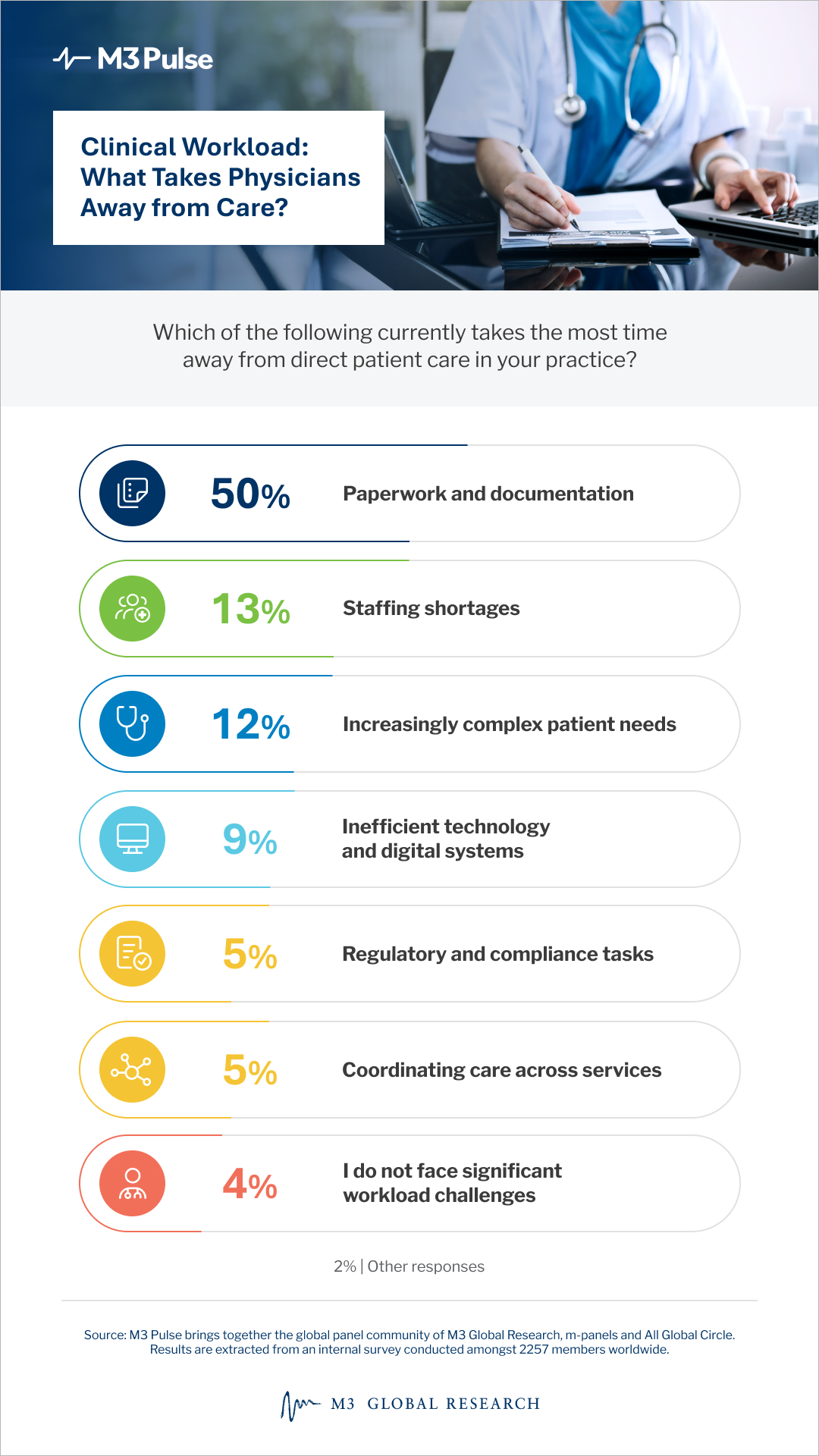
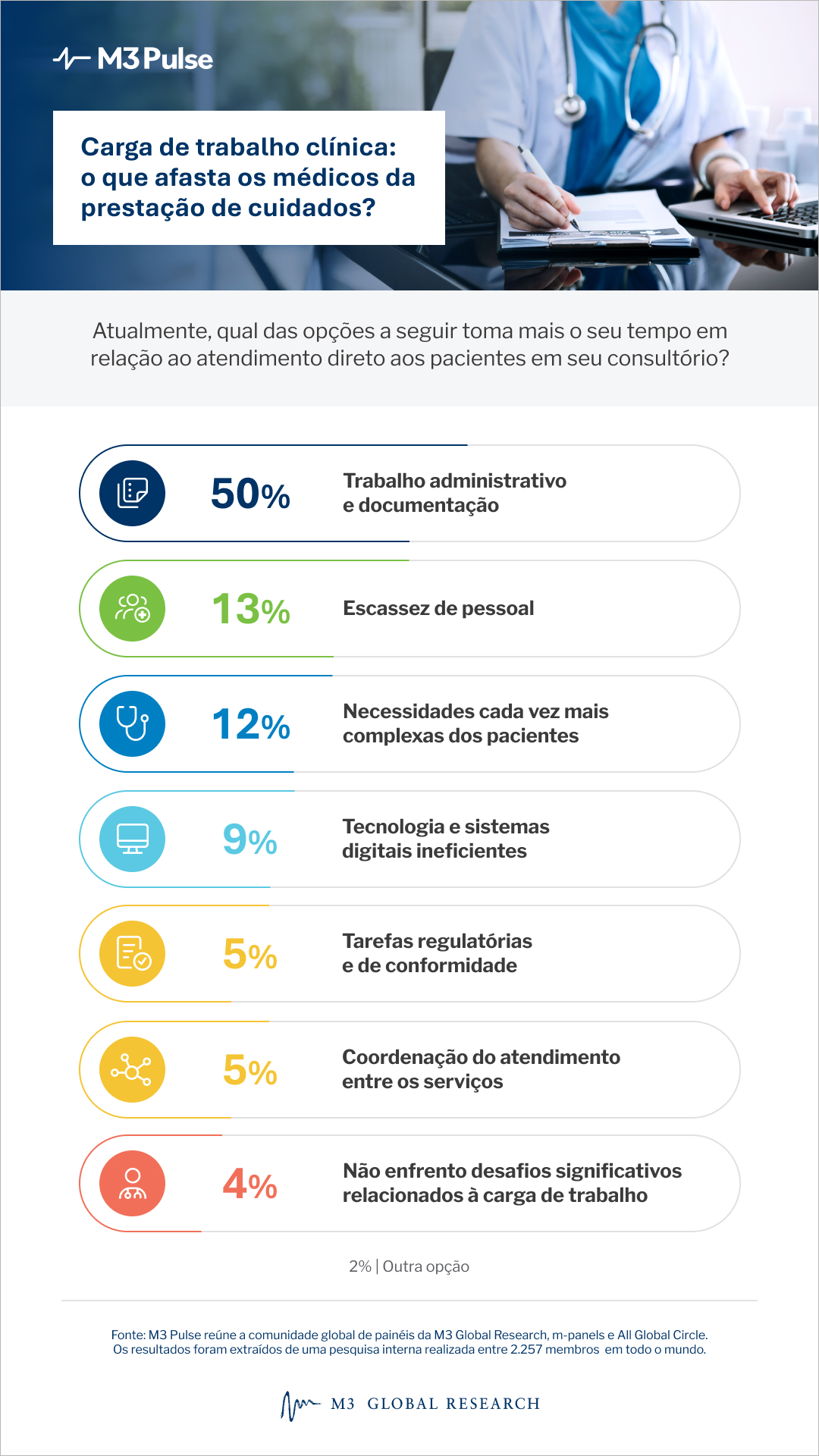
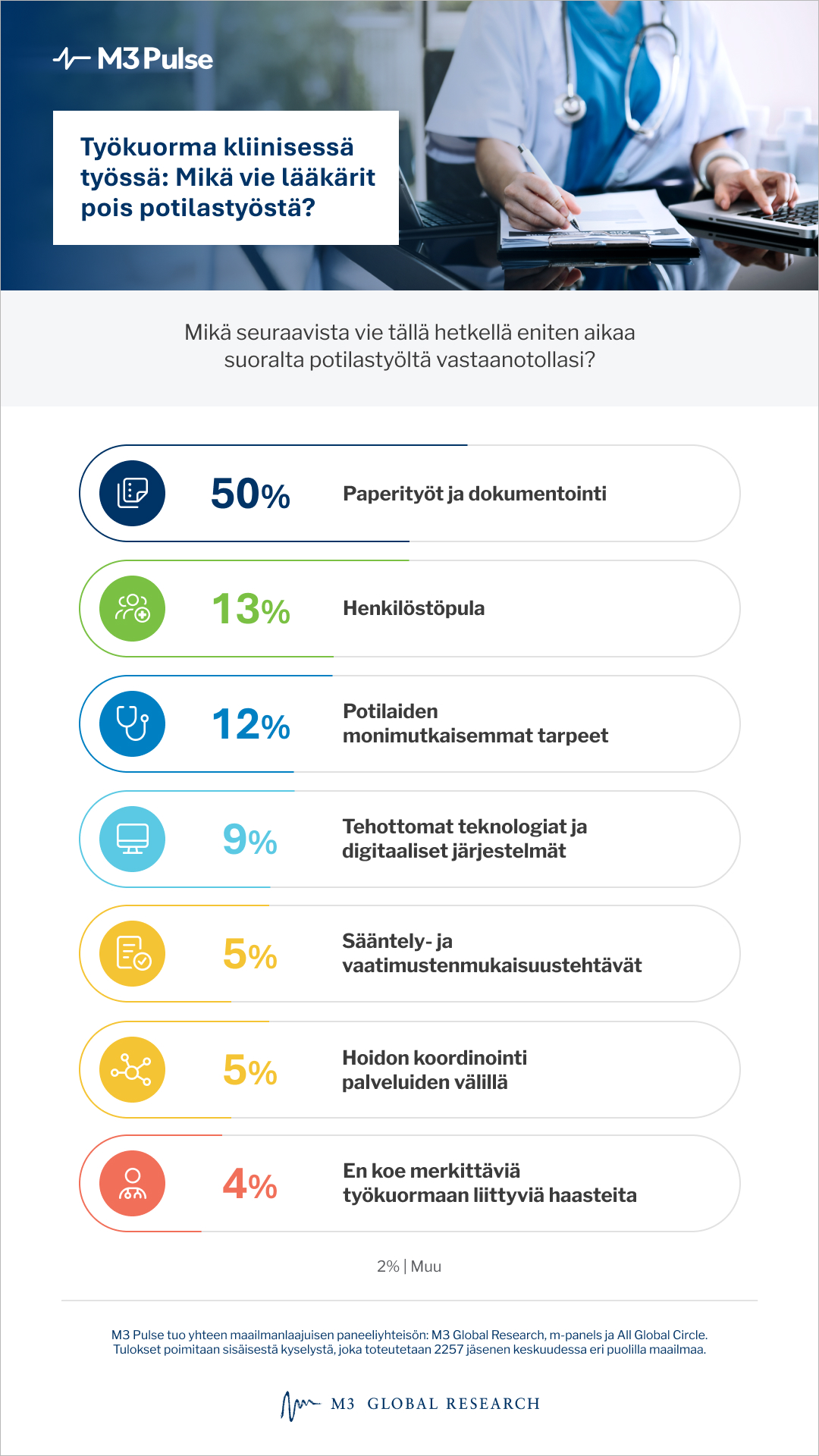
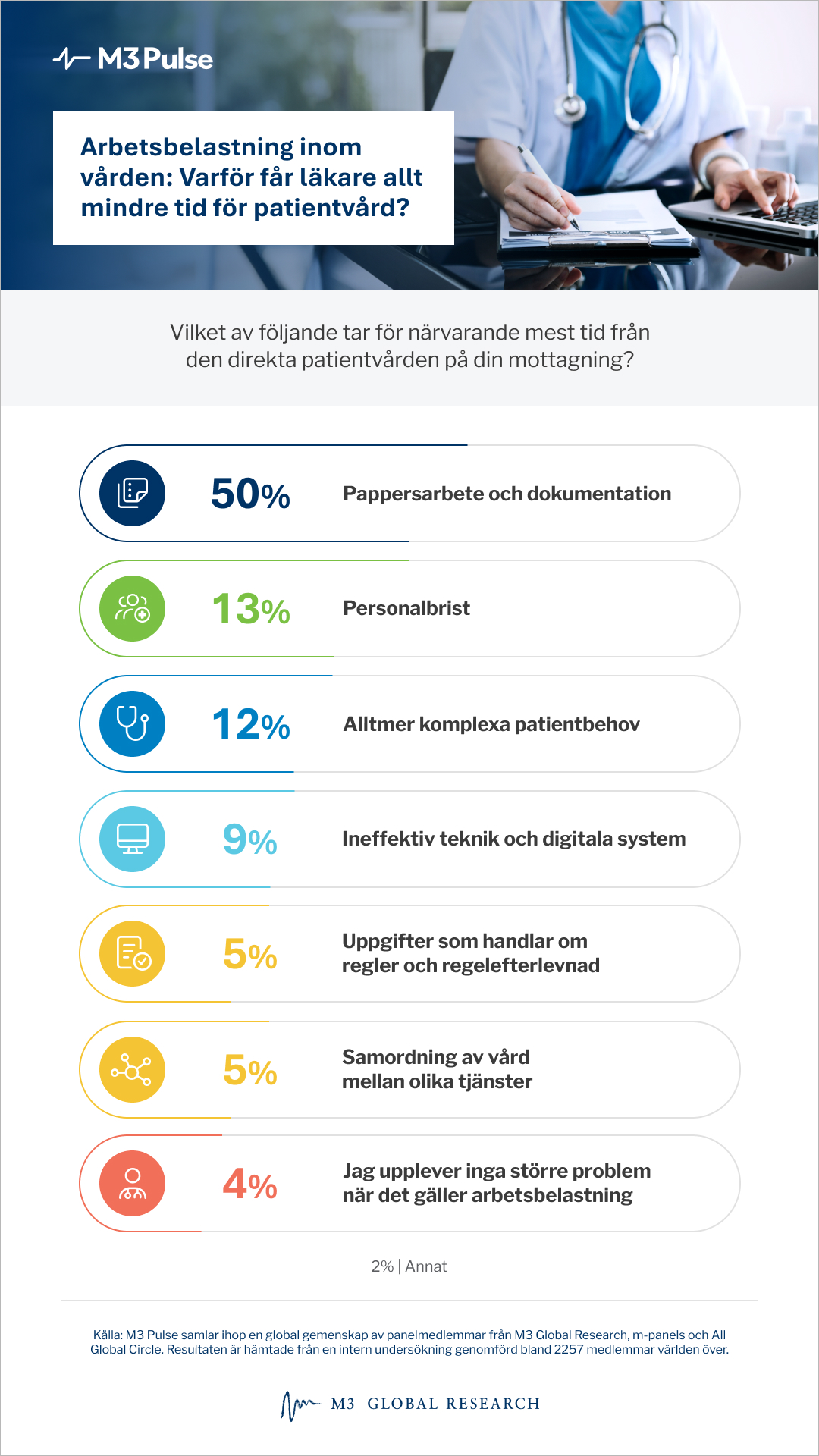
“Which of the following currently takes the most time away from direct patient care in your practice?”
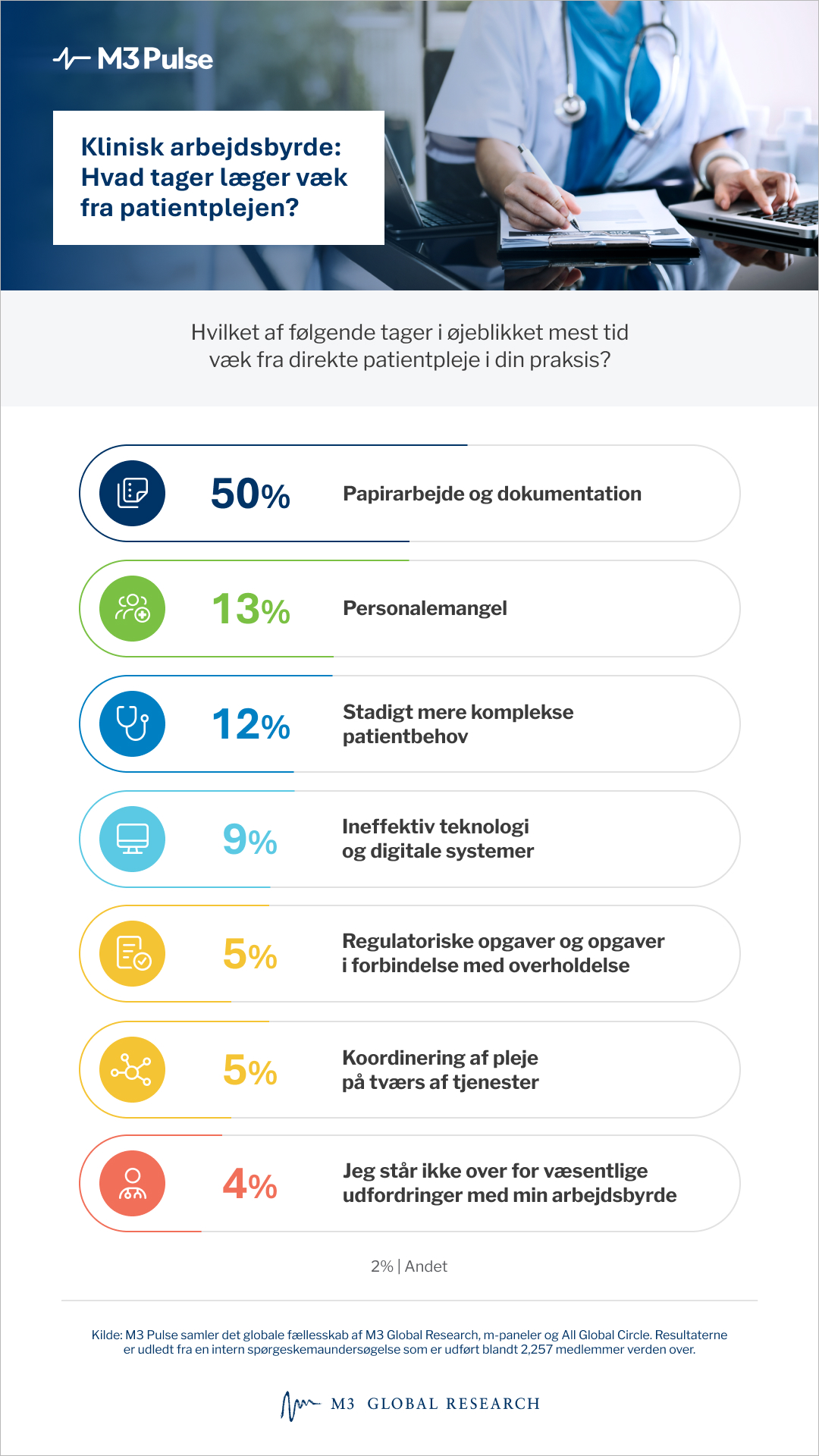
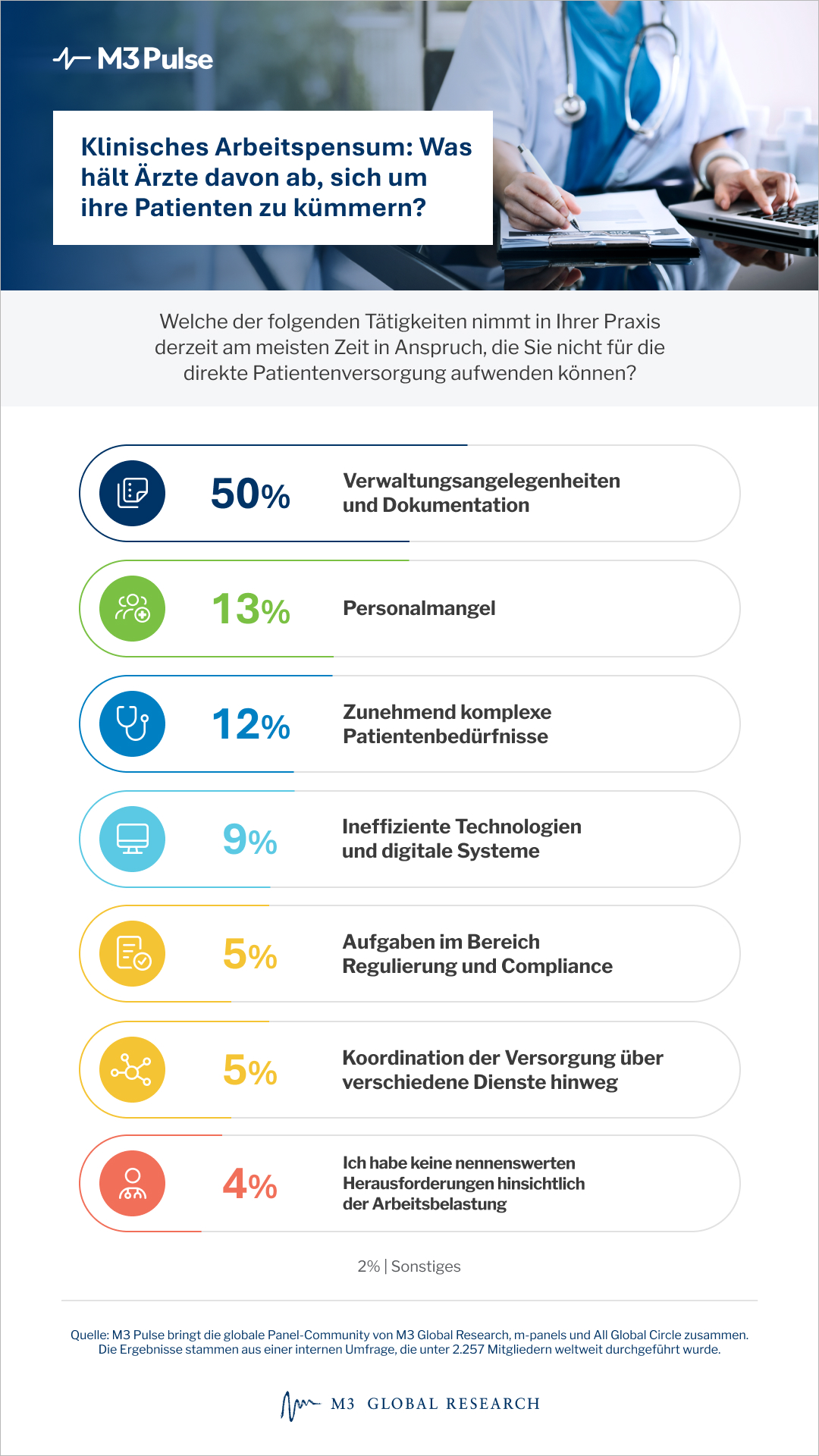
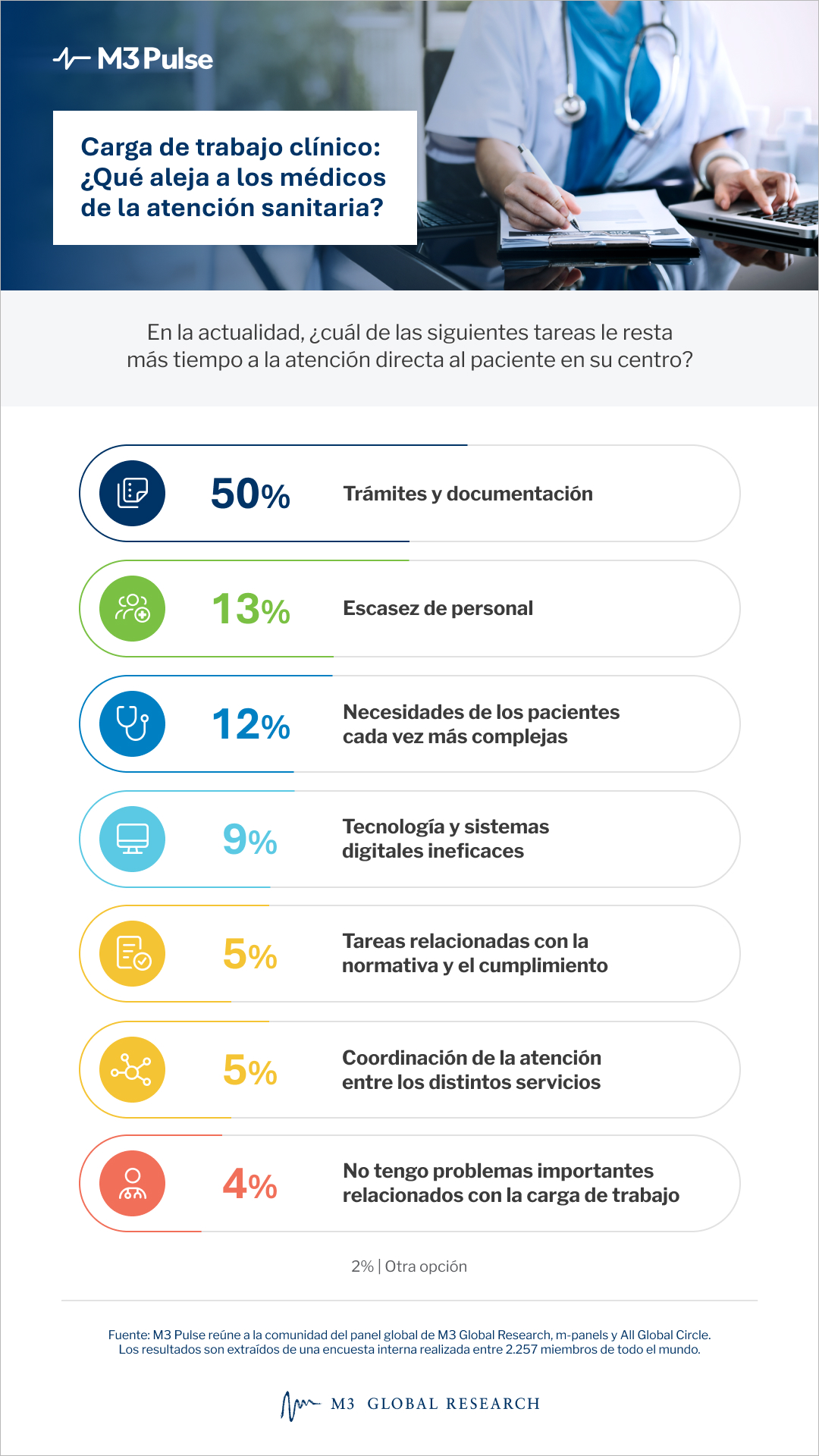
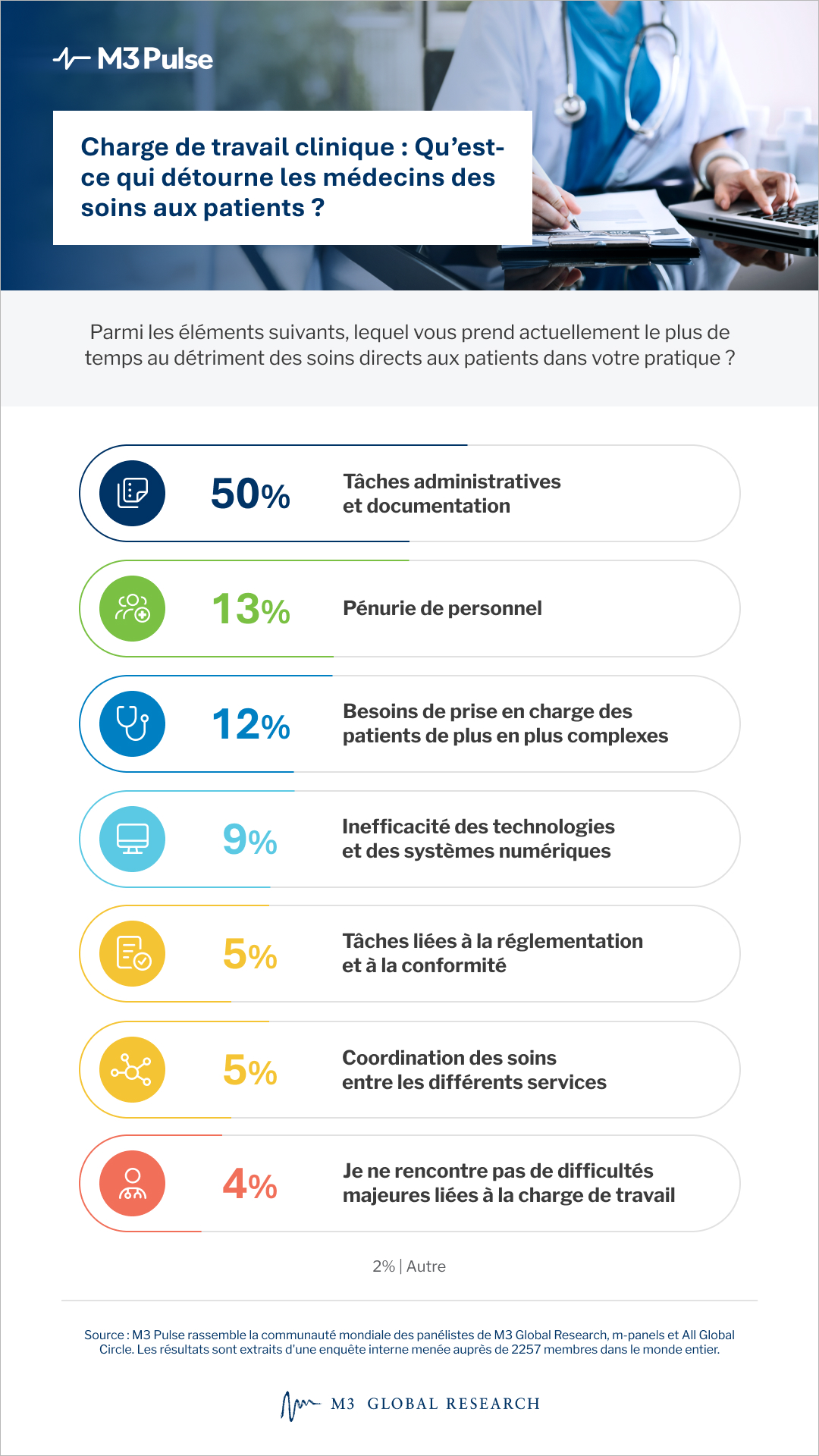
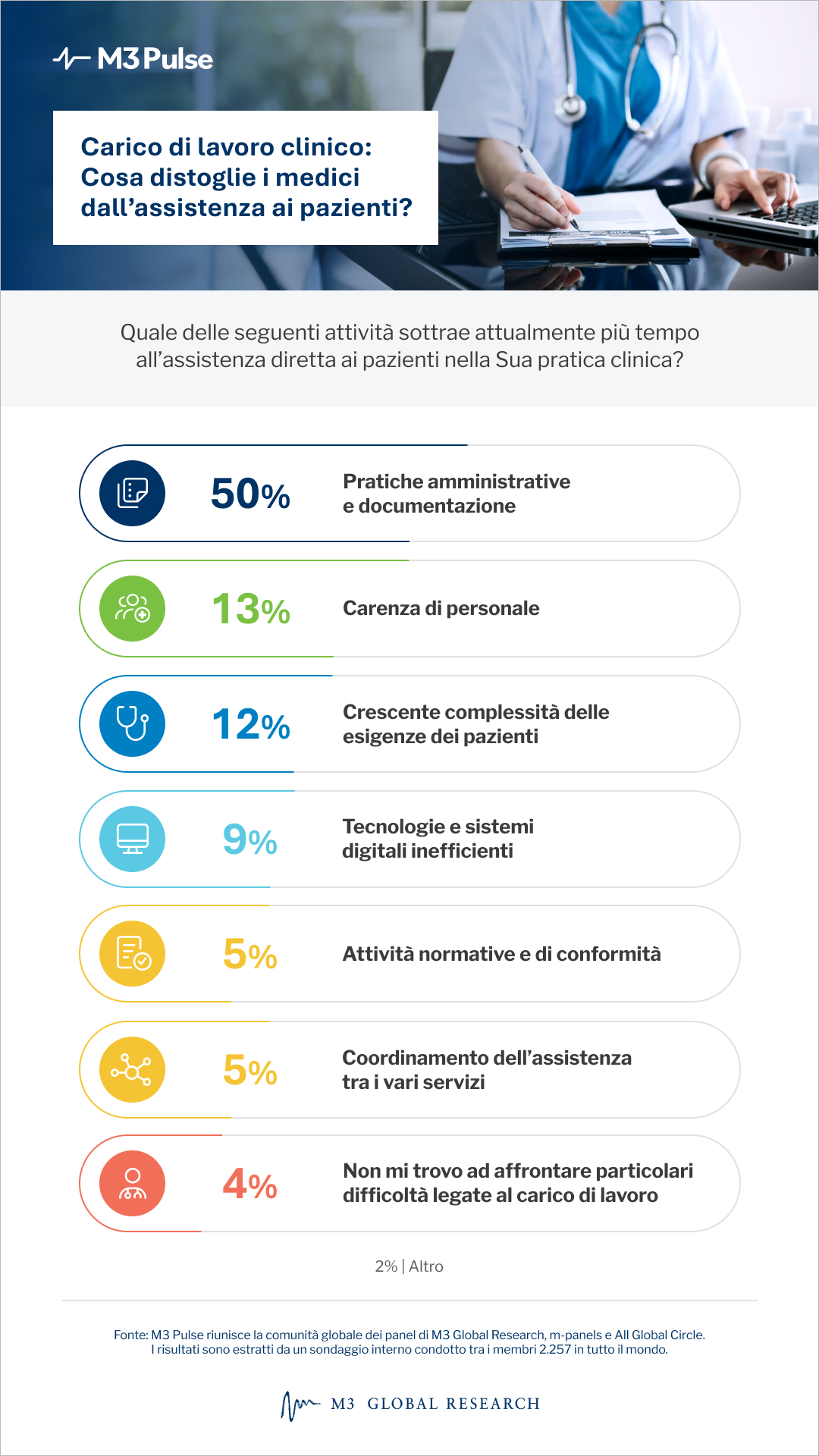
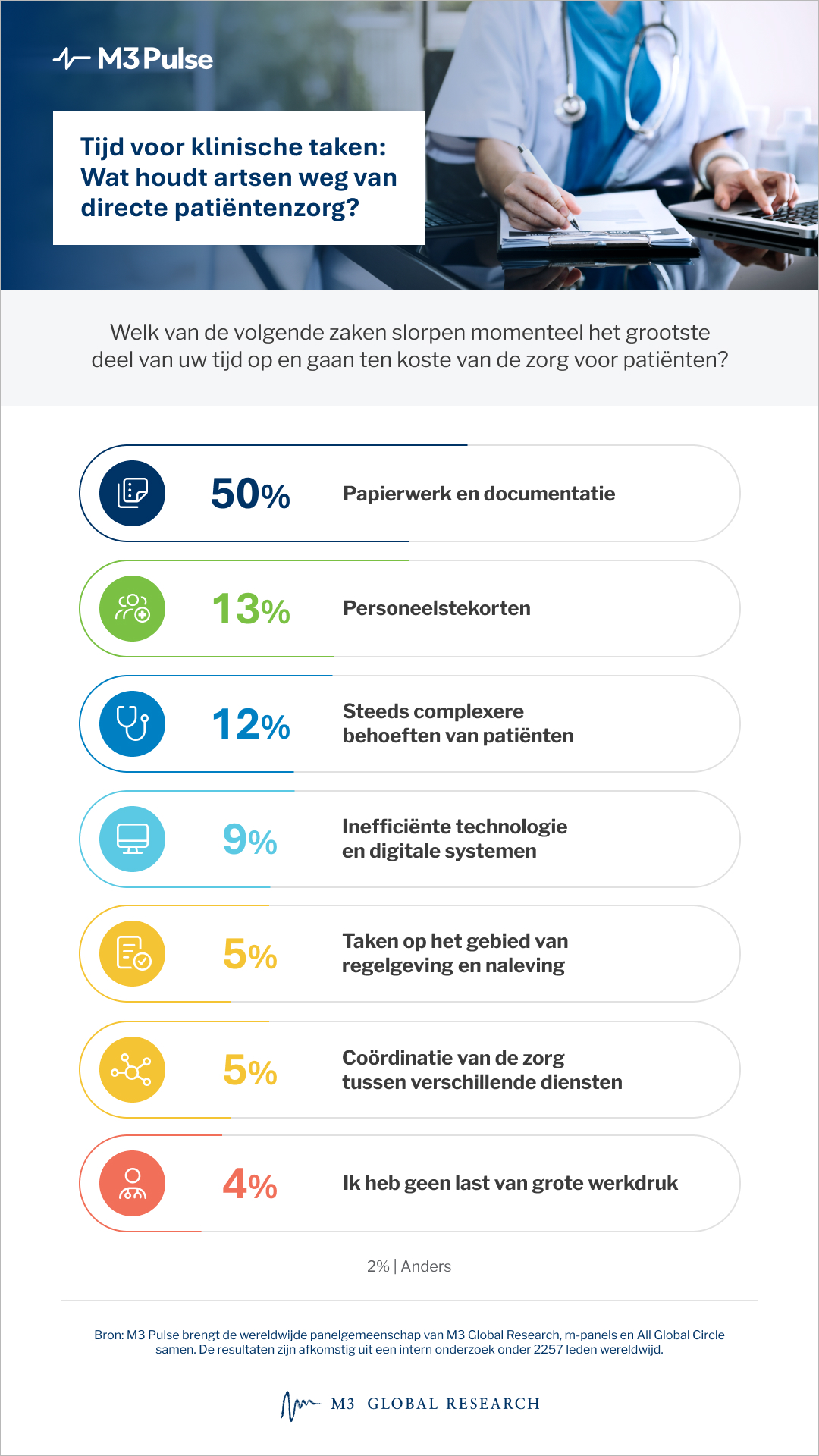
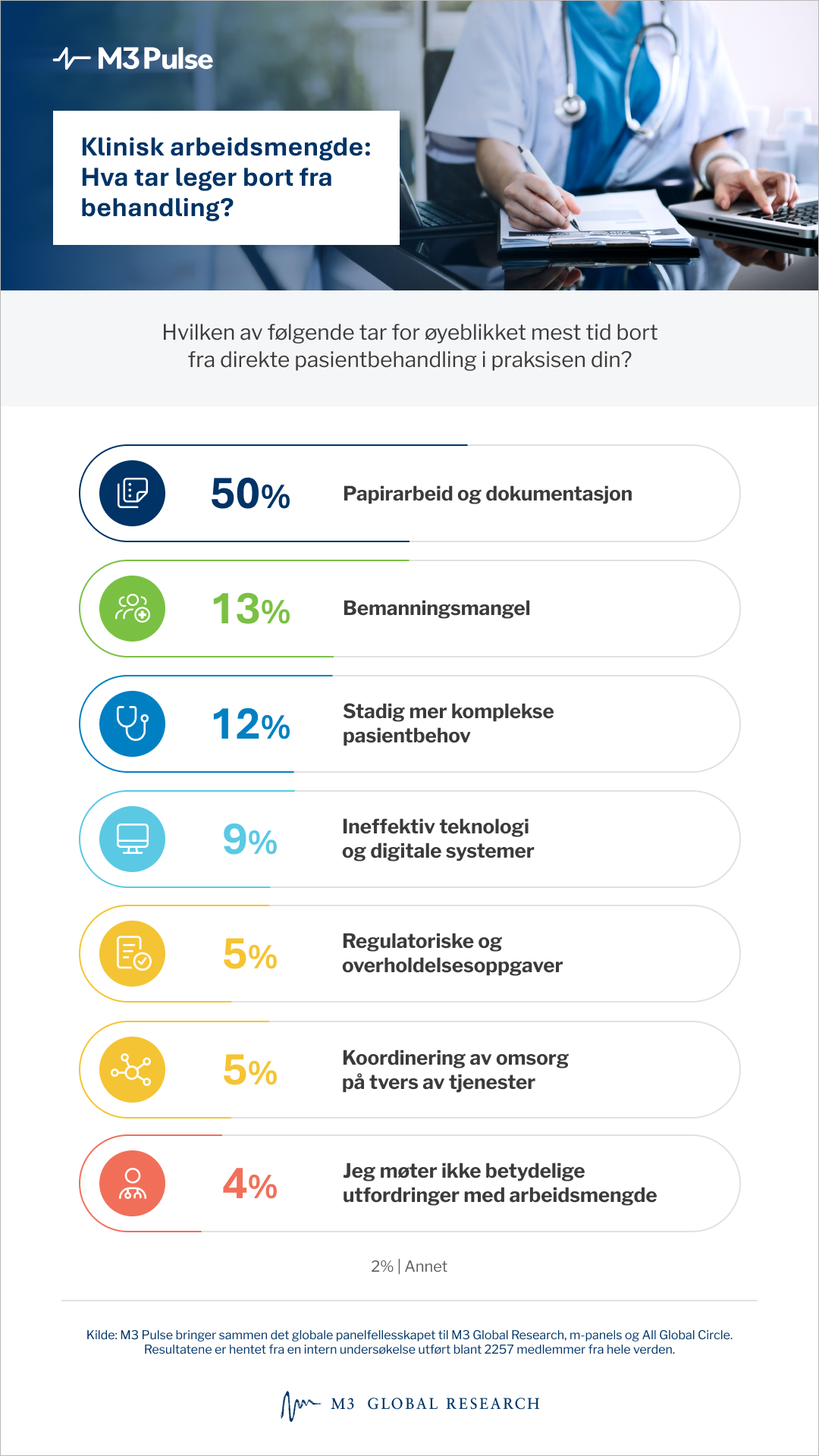
Among the options provided, 50% of physicians surveyed identified paperwork and documentation as taking the most time away from direct patient care, highlighting the prominence of administrative burden in their workload. This was followed by 13% who selected staffing shortages and 12% who pointed to increasingly complex patient needs. Smaller proportions of respondents identified inefficient technology and digital systems (9%), regulatory and compliance tasks (5%), and coordinating care across services (5%). A further 2% selected other pressures. Notably, 4% of physicians reported that they did not face significant workload challenges.
These findings highlight an important distinction. Physicians surveyed most often identified paperwork and documentation, rather than staffing shortages or increasingly complex patient needs, as taking the most time away from direct patient care. This suggests that understanding physician workload means looking beyond the demands of treating patients to the administrative burden surrounding everyday clinical practice.
This perspective is significant because it points to a practical focus for addressing physician workload: the processes surrounding everyday patient care. Rather than expecting physicians to fit more tasks into the same working day, it suggests that reducing administrative burden deserves greater attention. Simplifying documentation, improving digital systems, and reviewing how responsibilities are shared across teams are potential areas to explore when seeking to protect time for direct patient care.
*Please select your language
M3 Pulse is a one-question online survey we conduct every month with our M3 panel members. It´s a fun and easy way to share your opinions about trending healthcare topics, like the shortage of physicians, with healthcare professionals worldwide. If you want to participate in this month´s M3 Pulse, register and join the M3 panel today.

How Healthcare Systems Are Responding
Healthcare organisations are increasingly exploring technology-based interventions to reclaim physician time for direct patient care. Ambient documentation tools record clinical conversations and generate draft clinical notes for physician review. A 2024 study published in NEJM Catalyst*, drawing on a pilot involving over 10,000 physicians at The Permanente Medical Group in the United States, found that ambient AI documentation was associated with time savings equivalent to 1,794 eight-hour working days over the pilot period, alongside improvements in physician satisfaction and patient interaction quality.
Beyond individual technology tools, healthcare systems are examining care model redesign. Team-based care models that redistribute administrative and coordination tasks across multidisciplinary teams are gaining traction in several countries, while some systems are implementing cleaner workflow separation between clinical and administrative responsibilities. In primary care settings, expanded roles for practice nurses, pharmacists, and care coordinators are being used to absorb some of the workload that has historically fallen on the consulting physician.
The OECD has framed the administrative burden on physicians as a policy priority alongside workforce retention and system performance, linking the two directly in its analysis of European health systems. Policy responses in several countries include regulatory simplification, investment in interoperable digital systems to reduce duplication of documentation across care settings, and national initiatives to benchmark and reduce the time physicians spend on administrative tasks. How effectively these measures translate into restored time for direct patient care remains to be seen across different national contexts.

Towards a More Sustainable Physician Workload
Making physician workload more manageable means addressing administrative burden alongside staffing shortages in healthcare and the demands of complex patient needs.
AI tools may help ease the EHR documentation burden, but technology should be considered as part of a broader response that includes staffing support, clearer responsibilities and better care coordination.
Ultimately, efforts to address physician burnout should be judged not simply by how efficiently tasks are completed, but by whether physicians have the time and support they need for direct patient care. The goal is not to fit more work into the day, but to make that working day more sustainable.
What changes would help reduce your workload and protect time for direct patient care? Share your perspective in the comment section below.
Join the M3 Panel
Would you like to be rewarded for your medical expertise? Join M3 today and share your opinion